
Non-native temperate reptiles and amphibians may be able to survive in our climate so could harm native species if they are released or escape into the wild. It may also be an offence to release a non-native animal, or allow it to escape, into the wild.
Owners should follow the main Don't let them loose guidance, and additional guidance under Recommendations below to help prevent this from happening.
The following reptiles and amphibians are included on the list of species of special concern:
- Lithobates (Rana) catesbeianus, North American bullfrog
- Trachemys scripta, Terrapins - all subspecies including red-eared slider, yellow-bellied slider, Cumberland slider and common slider
If you own one of these species, there are other considerations that you must also check here:
- England and Wales: Invasive non-native (alien) animal species: rules in England and Wales - GOV.UK
- Scotland: Legislation and responsibilities.
You should also check whether your animal is listed under other legislation, including the Dangerous Wild Animals Act 1976 - particularly if you keep European species such as Montpellier snakes or Viperidae originating from temperate areas.

Recommendations
All reptiles and amphibians – read this first
- If you need to take your animal to the vets, or to boarding accommodation while you are on holiday, ensure it is transported in a container that it cannot escape from.
- Think about what would happen to your animal in the event of an emergency such as a flood or fire - what equipment would you need to hand to safely evacuate your animal?
- Plan for if your animal escapes - what steps would you take to recover them? See what to do if your pet escapes for guidance.
- Follow the Don’t let them loose guidance on what to do if you can no longer keep your pet.
Reptiles and amphibians kept in mesh cages
- Make sure doors are tightly fitting.
- Regularly check mesh for damage and holes through which animals could escape.
Reptiles and amphibians kept in open top enclosures (such as tortoises in tortoise tables or amphibians in open topped tanks)
- Make sure your animal can’t climb out – check that walls are tall enough, and that décor and plants are not positioned in a way that your animal can use them to climb.
- Use a tight-fitting mesh top to prevent escapes.
- Regularly inspect housing for damage.
More information on building a secure enclosure is available from the Tortoise Protection Group.
When keeping reptiles and amphibians outside
In addition to the measures above, when keeping animals outside you must:
- make sure their enclosures are secure so they can't escape into the wild
- ensure their enclosures are not on land that is at risk of flooding – you can check this on flood risk maps
- bury the walls of their enclosures at least 30 cm deep to stop animals from digging their way out
- check for damage to the enclosure every day
Reptiles and amphibians kept in a vivarium
- Make sure vents are installed correctly and facing the correct way around (see Figure 1 below) - if you’re not sure, try pushing the vent out from the inside of the vivarium to check that it stays in place.
- Keep runners free of substrate and make sure the glass closes properly.
- Secure the glass with a lock or window-wedge doorstop and make sure it is securely fastened whenever the vivarium doors are closed (see Figure 2 below for examples).
- Treat substrate, water or décor before disposing of it to ensure that it does not contain escaped animals, live-foods, or pathogens. This can be done by freezing waste material for 48 hours or baking it in an oven and chemically treating water to disinfect it.
More information on preventing escapes is available in a bulletin from the National Centre for Reptile Welfare.
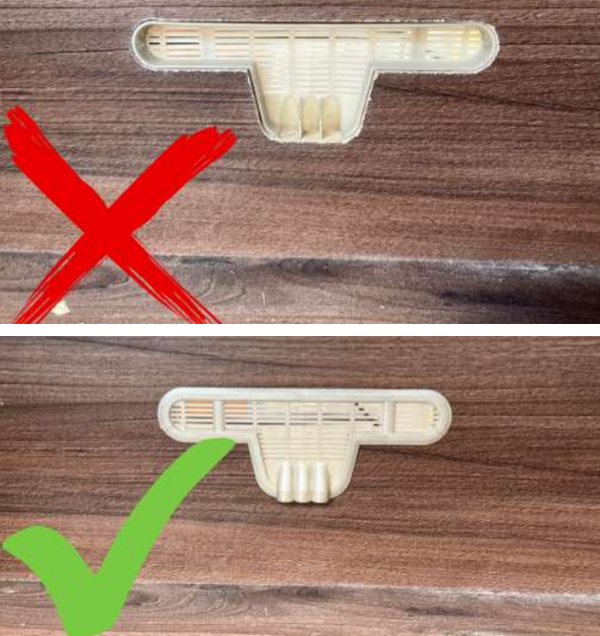
Figure 1: Incorrectly installed vent that could be pushed out from the inside of the vivarium (top) and correctly installed vent that could not be pushed out from the inside (bottom). Images: NCRW
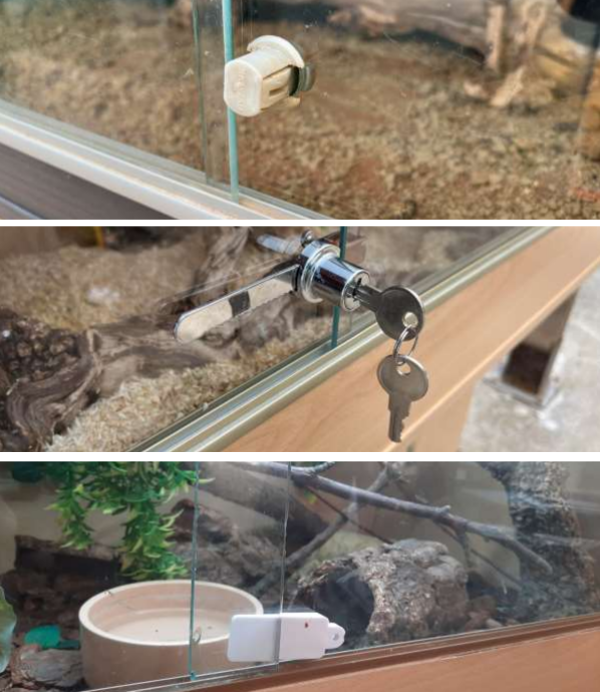
Figure 2: Examples of locks (top and middle) and a window wedge doorstop (bottom). Certain vivariums come with a lock that should be installed with the logo facing towards you (top). Images: NCRW