Invasive non-native species (INNS) are one of the world’s biggest environmental threats and cost the British economy almost £2 billion annually. The cost to water companies is at least £7.5 million per annum, a figure expected to rise as increasing numbers of invasive species arrive in the country.
In order to limit future costs, maintain services and help protect the environment, twelve water companies have invested £160k per annum for five years from 2025-2030, to tackle aquatic invasive species in England through an enhanced aquatic biosecurity programme. The GB Non-native Species Secretariat (NNSS) is leading on delivery of the work programme, overseen by a partnership steering group of water companies and key Check, Clean, Dry partners who are contributing to the project through their time and the activities of their organisation. The Check Clean Dry and Be Plant Wise awareness raising campaigns are funded through this project.
The partnership



Work programme
The work programme consists of five key areas:
- Border campaign: run an annual six-month Check, Clean, Dry campaign at the border between March and September to target GB anglers / boaters bringing their equipment back from the Continent, and continental anglers / boaters bringing equipment to GB.
- Communications products: continue to promote the Check, Clean, Dry and Be Plant Wise campaigns, refining our communications products, including bespoke materials for key audiences, and deploying products at optimal locations to influence behaviours.
- Practical biosecurity: provide biosecurity facilities and demonstrations at key sporting events and provide resources to encourage uptake of biosecurity.
- Training: continue to deliver biosecurity training for key groups (e.g. for water asset managers, event organisers, and clubs, and professional horticulturalists, students / researchers, and gardening groups) and develop a network of trainers, talks and articles in specialist magazines. Update the water industry e-learning and develop further training materials as required.
- European work: expand previous work with Belgian, French and Dutch partners to improve aquatic biosecurity in mainland Europe, targeting the most significant European ports.
2017 to 2025
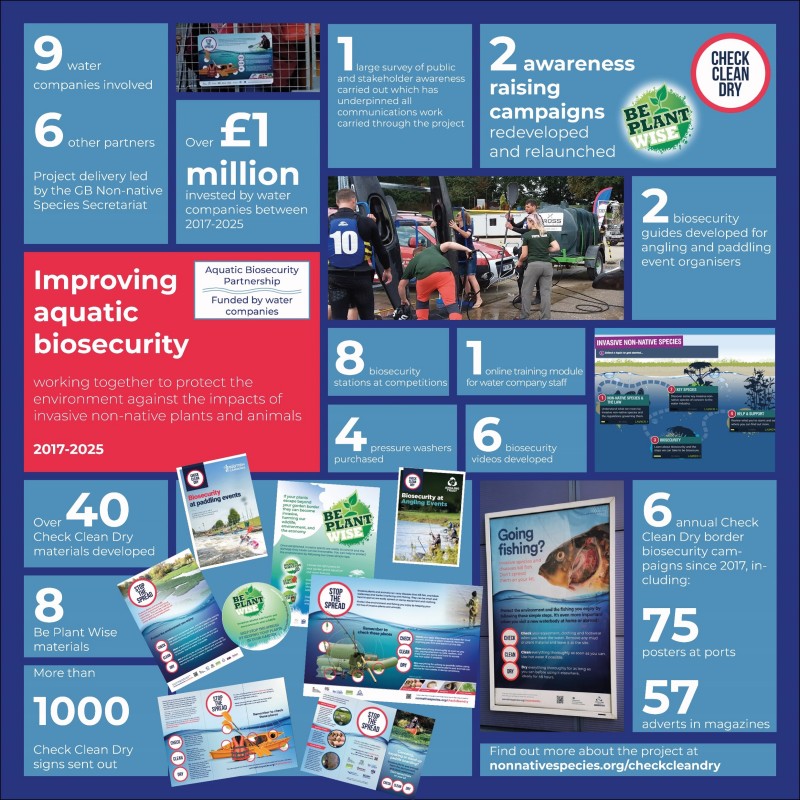
This project is building on two previous phases which took place from 2017-2020, and 2020-2025. Between 2017 and 2025, over £1 million was contributed by ten water companies, with nine involved in the second phase of the project. The following organisations were involved: Anglian Water, Angling Trust, British Canoeing, British Rowing, Defra, Environment Agency, Northumbrian Water, RYA, Severn Trent Water, South East Water, Southern Water, South West Water, Thames Water (phase one), Yorkshire Water.
Key achievements
Key achievements of the 2020-2025 project include:
- Reducing the risk of introduction of new INNS to GB by leading five annual six-month border biosecurity campaigns targeting recreational water users travelling abroad, including 82 posters / adverts at key ports and 70 adverts in specialist magazines and on their websites and social media.
- Disseminating over 116,000 Check, Clean, Dry materials to the campaign audiences with the help of partners.
- Improving biosecurity at aquatic sites across England, including water company assets and 62 sites in England and Wales where priority species (quagga mussel and killer shrimp) have been found (in progress).
- Working with national governing bodies to improve biosecurity at large aquatic sporting competitions by providing temporary biosecurity / washdown stations at 15 large events in England and Wales, developing event biosecurity toolkits for angling and paddling, and attending two international competitions to remind participants to Check, Clean, Dry equipment and clothing before returning to GB.
- Redeveloping the Be Plant Wise campaign to prevent the spread of invasive pond and garden plants, advertising in 1.8 million copies of Gardeners’ World Magazine, attending 11 large horticultural events, and disseminating over 16,000 campaign materials to gardeners.
- Commissioning a review of the 2016 UKWIR report on INNS implications on the water industry, to provide evidence of current impacts and costs, and progress made by water companies in carrying out previous recommendations to reduce these impacts (in progress).