Some of the PDF documents in this section are not fully accessible to screen reader software. If you need information from this section in a different format, email [email protected]. We’ll consider your request and get back to you in 15 working days.
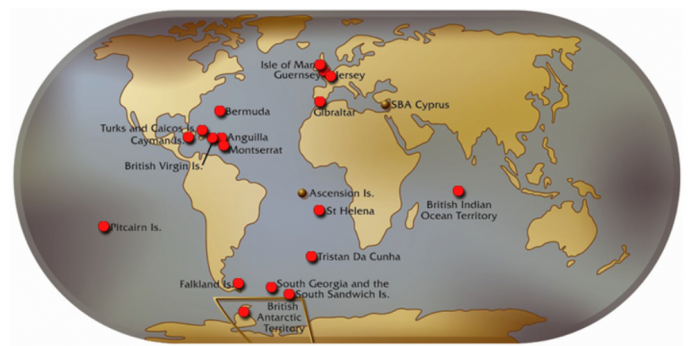
The UK has 14 Overseas Territories (OTs)* and three Crown Dependencies, all of which are islands except for the British Antarctic Territory, Cyprus Sovereign Base Areas and Gibraltar. The OTs together account for 94% of the UK's unique species and as such make a significant contribution to global biodiversity.
*On 22 May 2025, the UK Government and Government of Mauritius signed a treaty to ensure the continued operation of the UK-US military base on Diego Garcia. At the point that the treaty comes into force, Mauritius will be sovereign over the Archipelago and the British Indian Ocean Territory (BIOT) will cease to be a British Overseas Territory.
Information on the OTs
- How do invasive non-native species impact on the OTs?
- How is UK Government responding?
- The OTs Biosecurity Project
- Learn about each Territory
- Biosecurity travel advice for visitors to the OTs
Resources for OTs
- Biosecurity toolkits
- Pest Risk Assessment resources
- Communications and education materials
- Horizon scanning results
- Prioritising containment and eradication action
- UK Overseas Territories database of Alien Species developed through a UK Centre for Ecology & Hydrology project: Enhancing monitoring and prevention of invasive non-native species across UKOTs | UK Centre for Ecology & Hydrology
How do invasive non-native species impact on the OTs?
The impacts of invasive non-native species on small islands are often much worse than elsewhere because the native flora and fauna have evolved in isolation from predators, competitors and diseases. As a result native species are less able to compete and defend themselves in the face of new threats. Since 1500 72% of global extinctions have occurred on islands and 67% of birds on oceanic islands are threatened by invasive non-native species (Baillie et al 2004). Being predominantly islands, the OTs are very vulnerable to the introduction of potentially harmful invasive non-native species, recognised as the biggest threat to island biodiversity, as well as to food security and sustainable development.
UK Government response
The UK Overseas Territories Biodiversity Strategy presents a single joint ambition of the UK Government and governments and administrations of the OTs to conserve, protect, and restore biodiversity and champion the benefits of nature.
This strategy was co-created with the OTs following an extensive JNCC-supported consultation to span the key issues, challenges and opportunities facing biodiversity in these unique environments.
The strategy flags invasive non-native species as a key threat to biodiversity across the OTs and lays out the routes to address it.
Read the UK Overseas Territories Biodiversity Strategy
Darwin Plus
Running since 2012, Darwin Plus is Defra’s flagship programme to support biodiversity and conservation projects in the OTs. Projects are supported through four competitive grant schemes tailored for different needs:
- Darwin Plus Main;
- Darwin Plus Local;
- Darwin Plus People & Skills; and
- Darwin Plus Strategic.
Darwin Plus has supported a diverse portfolio of projects to strengthen biosecurity and tackle invasive non-native species; see Darwin Plus News to find out more.
The OT Biosecurity Project
Tackling Invasive Non-native Species in the UK Overseas Territories
Since 2016, the Animal and Plant Health Agency (APHA) has delivered the OTs Biosecurity Project to manage and reduce the risk from invasive non-native species and their impacts on biodiversity, agriculture, human health and economies.
The project provides capacity to OTs for biosecurity legislation, regional training, rapid responses to emerging threats, horizon-scanning and support to Darwin Plus projects.
The OTs Biosecurity Project was initially funded over 5 years by the FCDO’s Conflict, Stability and Security Fund (CSSF) and has been funded by Defra since 2022.
Read more on the activities and achievements of the OT Biosecurity Project:


One Health approach
The one-health approach recognizes that the health of humans, animals and ecosystems are interconnected. It involves applying a coordinated, collaborative, multidisciplinary and cross-sectoral approach to address potential or existing risks that originate at the animal-human-ecosystems interface.
As the OTs move forward it is essential that the one health approach is accepted and promoted, recognizing biosecurity as an all-inclusive term that includes policy and regulation to protect agriculture, food and the environment from biological risk.
Read more on the one-health approach (pdf).