
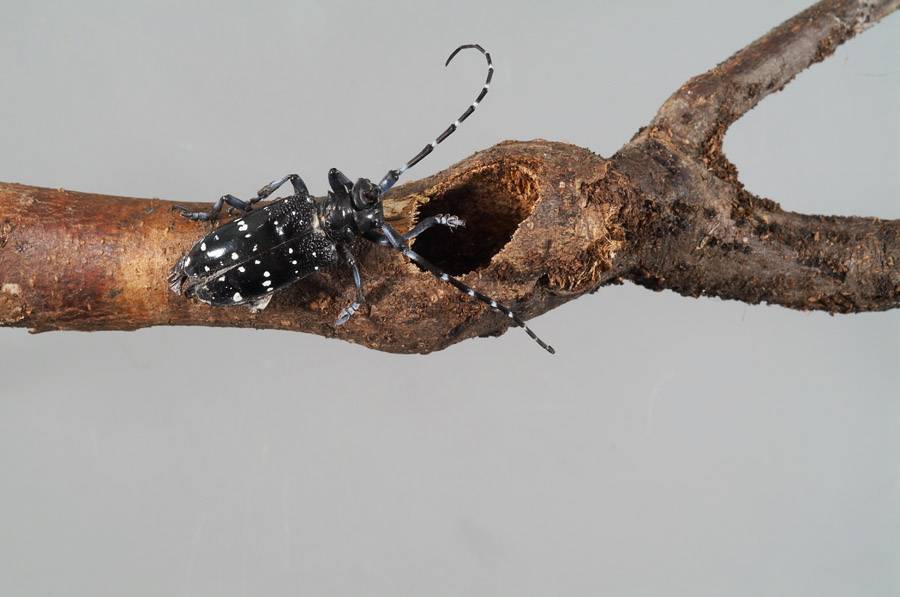
Citrus longhorn beetle - Anoplophora chinensis
Expand and collapse the sections below by clicking on the title or + / - icons.
Short description of Anoplophora chinensis, Citrus longhorn beetle
Large, 21- 37 mm long, stout beetle with shiny black elytra marked with variable white markings; long black antennae marked with white or light blue bands; polyphagous insect attacking over 100 species of broadleaved trees and shrubs.
Impact summary: Anoplophora chinensis, Citrus longhorn beetle
Citrus longhorn beetles have been moving around the world in ornamental trees from Asia. They pose a serious threat to horticulture, forestry and native trees in GB. Feeding by the larval stages creates tunnels in host trees and make trees susceptible to diseases and wind damage.
Habitat summary: Anoplophora chinensis, Citrus longhorn beetle
Citrus longhorn beetles have intercepted most commonly on Japanese maple trees. However, it can affect a wide range of trees and shrubs, including many important native and introduced species of broadleaved trees in GB. Most of the trees grown in cities and towns in England and Wales are potential hosts including: Acer spp. (maples), Aesculus hippocastanum (horse chestnut), Alnus spp. (alder), Betula spp. (birch), Carpinus spp. (hornbeam), Citrus spp., Corylus spp. (hazel), Cotoneaster spp., Fagus spp. (beech), Lagerstroemia spp., Malus spp. (apple), Platanus spp. (plane), Populus spp. (poplar), Prunus spp. (cherry etc.), Pyrus spp. (pear), Salix spp. (willow), and Ulmus spp. (elm).
Overview table
| Environment | Terrestrial |
|---|---|
| Species status | Non-Native |
| Native range | Asia-Temperate, Asia-Tropical, China, Malesia, Kazan-retto, Nansei-shoto, Ogasawara-shoto, North Korea, South Korea, Myanmar, Philippines, Taiwan, Hawaiian Is., Vietnam |
| Functional type | Herbivore |
| Status in England | Non-Native |
| Status in Scotland | Non-Native |
| Status in Wales | Non-Native |
| Location of first record | Interception of maple trees (Acer palmatum) since 2005 - imported from China via The Netherlands in January 2008 |
| Date of first record | 1921 |
Origin
Native to China, Japan and other countries in South East Asia.
First Record
The first GB interception was in 1921 when a single adult beetle emerged from a bonsai at a nursery in Hertfordshire. There were very few further interceptions until 2005 when a number of beetles and larvae were intercepted on a consignment of Acer trees imported from China. In 2008 further beetles were found in private gardens in GB as well as on a nursery in Guernsey. The findings were on maple trees (Acer palmatum) imported to Guernsey from China via the Netherlands in January 2008. The infested trees in GB had been been distributed from Guernsey by mail order. The findings in Guernsey were on trees that had not yet been distributed. There were further findings in 2009 and 2010 with beetles caught in private gardens having emerged from maple trees purchased over the last three years.
Pathway and Method
Citrus longhorn beetles have been intercepted in GB at nurseries, bonsai traders and in private gardens on imported trees and bonsai from China, Japan and South Korea. The most common hosts have been maples particularly Japanese maple, Acer palmatum, trident maple, A. buergerianum and imported dwarf apple trees, Malus spp. bonsai.
Species Status
Not established in GB. In 2000 an outbreak of the beetle was discovered in Lombardia, Italy. This outbreak is now too widespread for eradication to be possible, however containment measures are being implemented. Outbreaks of the pest have also been discovered in Soyons, France (first discovered in 2003), Westland, the Netherlands (2007), Rome (2008) and Boskoop, the Netherlands (2009).
Dispersal Mechanisms
Natural dispersal of adults is through flight but evidence from studies on Asian longhorn beetles, <em>Anoplophora glabripennis</em>, indicate dispersal is generally less than 400 m (maximum 1-2 km). Long distance dispersal (between countries) is through movement of host trees for nursery trade
Reproduction
Citrus longhorn beetles have a 1-2 year life cycle in their native range, but this can be extended in cooler climates. Average adult fecundity is 15 eggs but a single female is capable of laying up to 200 eggs. Eggs are laid under the bark at the base of the trunk. Young larvae hatch within one to three weeks and initially feed on the green, sappy portion of the inner bark moving to the woodier parts at late larval stages. The pupal stage lasts for four to six weeks until a pre-adult is formed. The pre-adult is inactive and takes about one to two weeks to mature and emerge out of the tunnel through exit holes.
Known Predators/Herbivores
The pathogenic fungi <em>Beauveria brongniartii</em> is known to cause high adult mortality. Wasp parasitoids <em>Aprostocetus anoplophorae</em> n. sp. (Eulophidae) and <em>Spathius erythrocephalus </em><em>(Braconidae)</em><em> </em>have both been seen attacking citrus longhorn beetles in Italy.
Resistant Stages
None known.
Habitat Occupied in GB
Not established in GB.
Environmental Impact
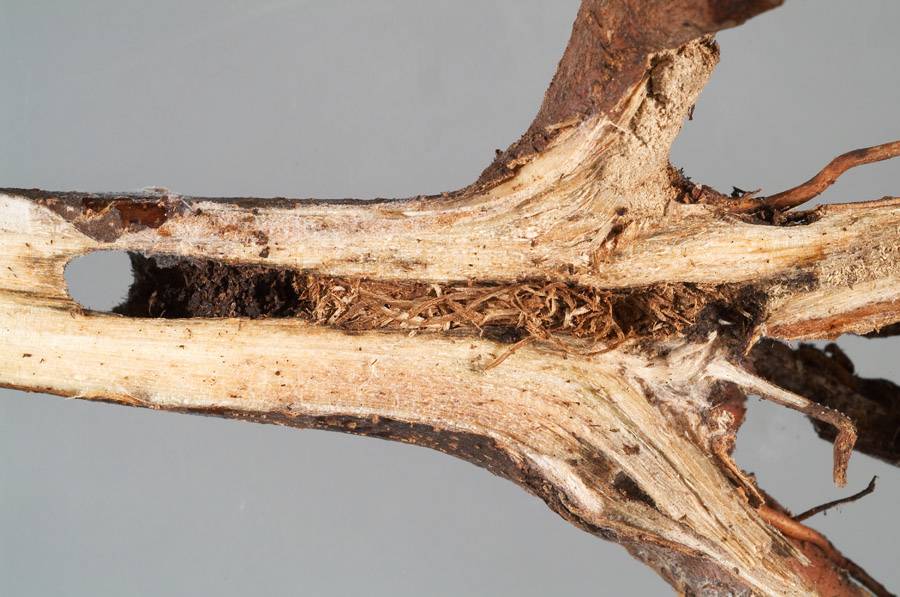
In Italy, the damage caused by citrus longhorn beetles has been in urban areas. Most of the trees grown in cities and towns in England and Wales are potential hosts including citrus, apples, beech, birch, hawthorn, hazel, horse chestnut, plane, poplar, oak and willow. The larvae feed internally on the pith and vascular systems of the lower trunk and roots. The tunnels created by the feeding leave trees susceptible to disease and wind damage. The adults can cause more limited damage by feeding on foliage and eating young bark.
Health and Social Impact
None known.
Economic Impact
Economic loss of amenity value host trees is likely to be significant. The costs of control measures should also be considered. Between 2008-2010, Lombardia plant health service planned to spend €10 million on eradication measures. A closely related species, the Asian longhorn beetle, <em>Anoplophora glabripennis</em>, caused the destruction of thousands of trees in the USA and eradication campaigns have cost $800 million.

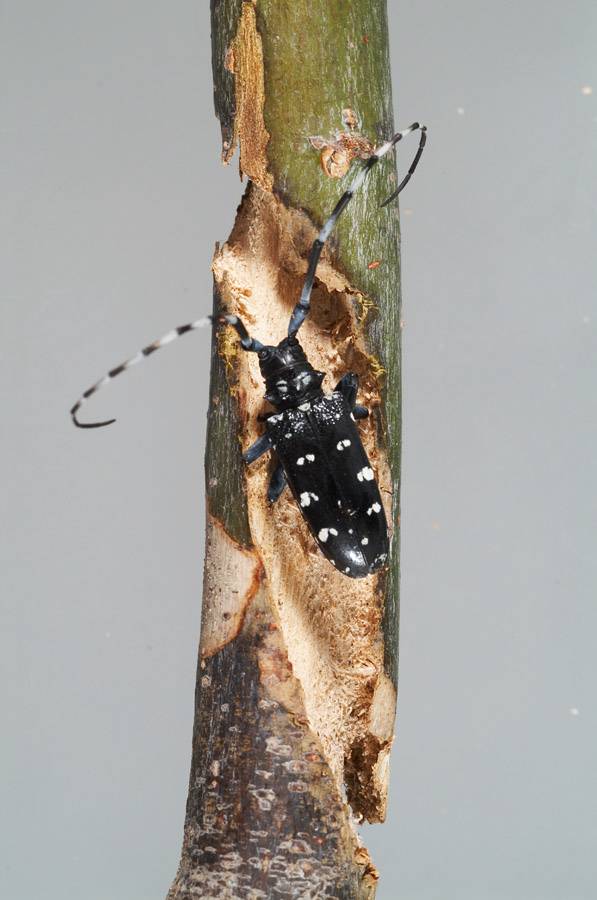
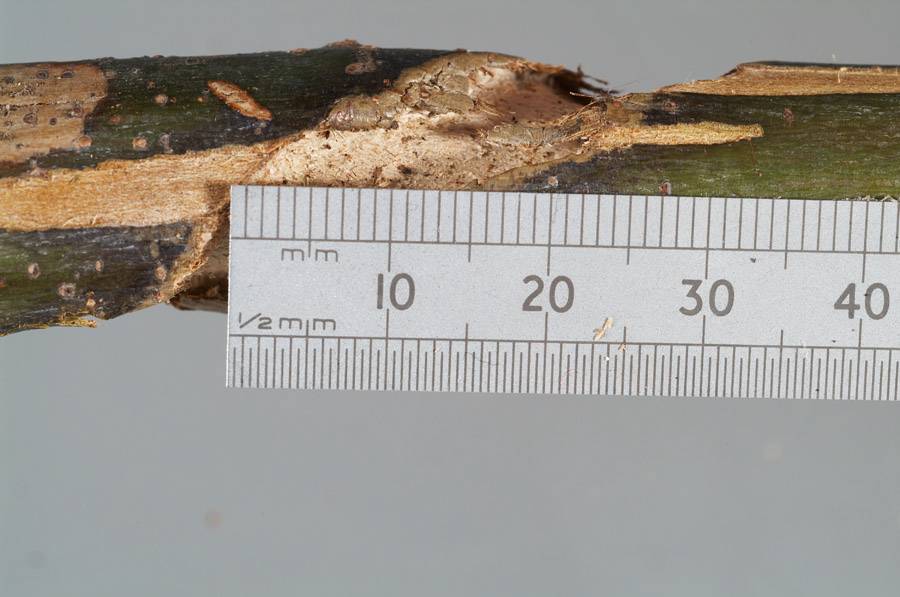
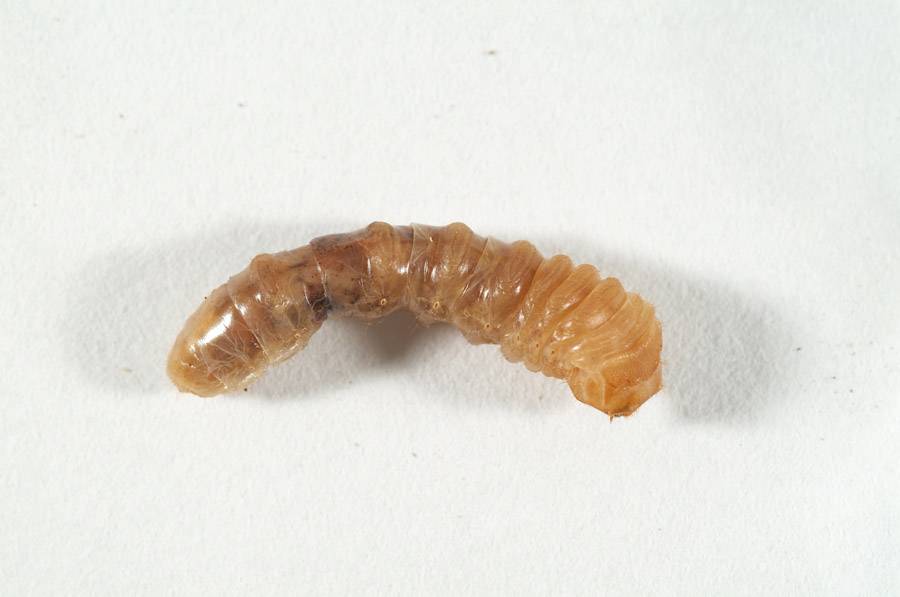
Identification
CABI. (2004). Crop Protection Compendium.
Biology, ecology, spread, vectors
University of Florida's Institute of Food and Agricultural Sciences Fact Sheet
Management and impact
University of Florida's Institute of Food and Agricultural Sciences Fact Sheet
General
Spotted this species?
Distribution map
View the Distribution map for Citrus longhorn beetle, Anoplophora chinensis from NBN Atlas
A horizon scanning exercise conducted in 2025 identified this species as one of the top 20 non-native species most likely to become invasive in Britain over the next ten years.