
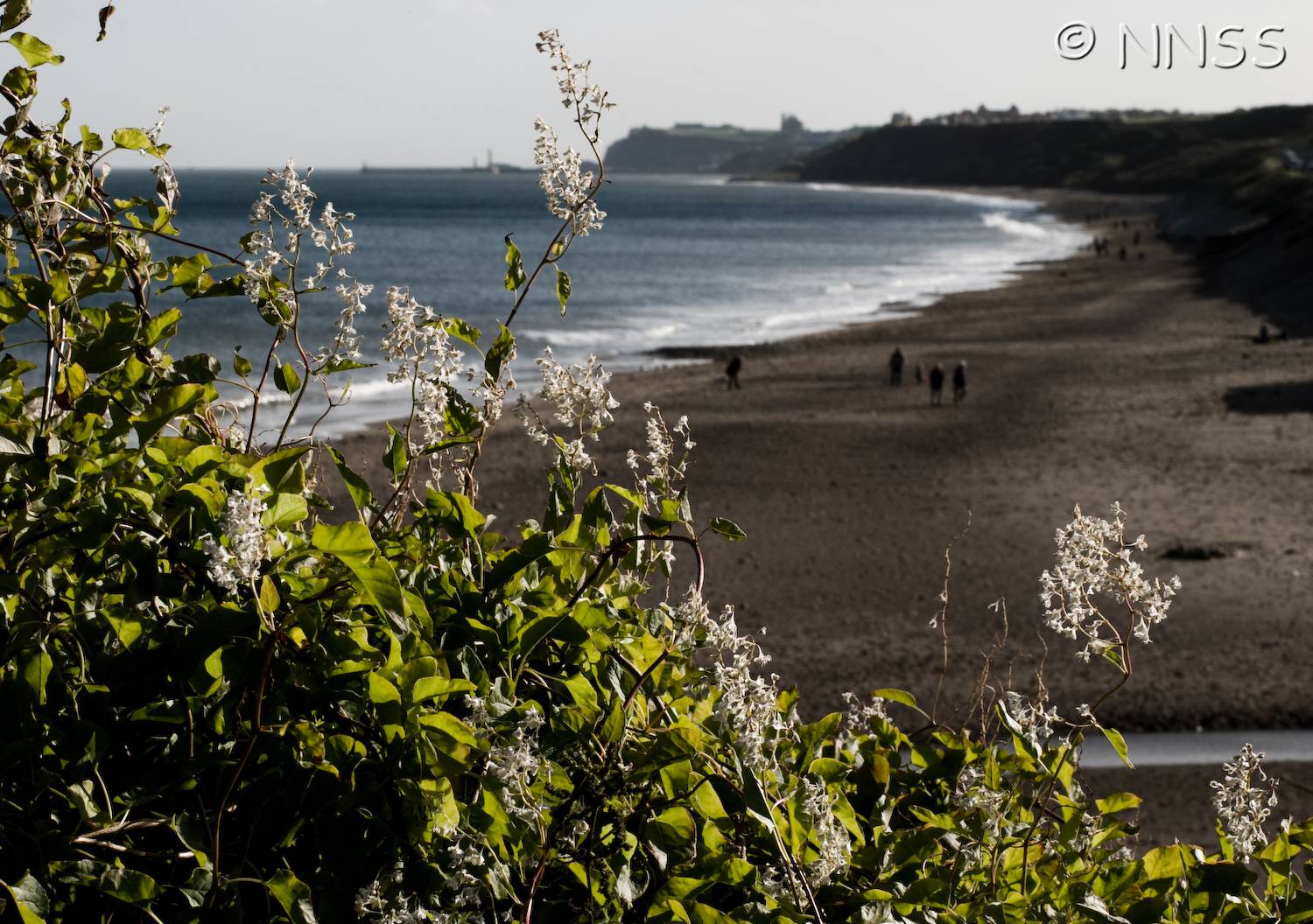
Russian Vine - Fallopia baldschuanica
Expand and collapse the sections below by clicking on the title or + / - icons.
Short description of Fallopia baldschuanica, Russian Vine
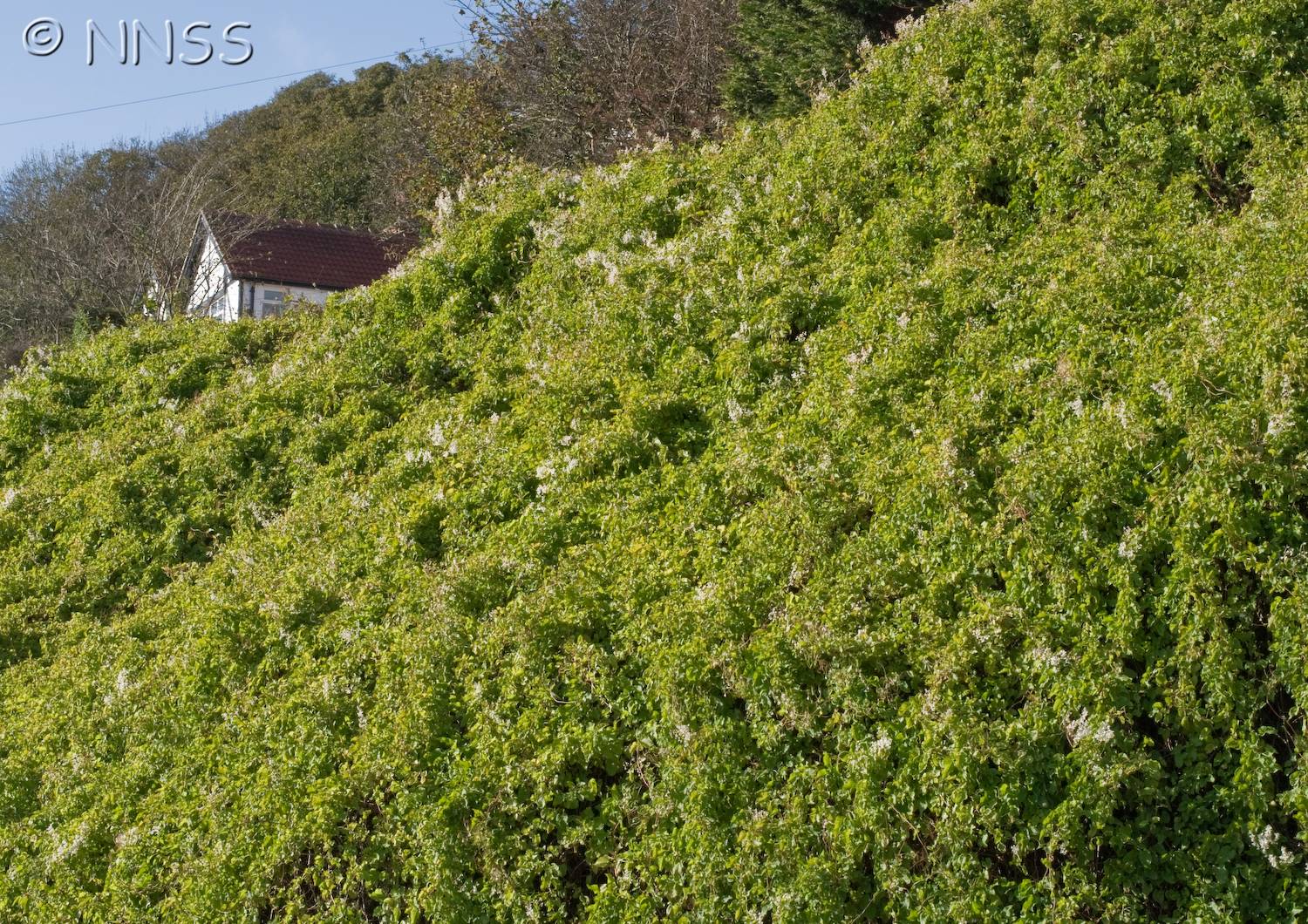
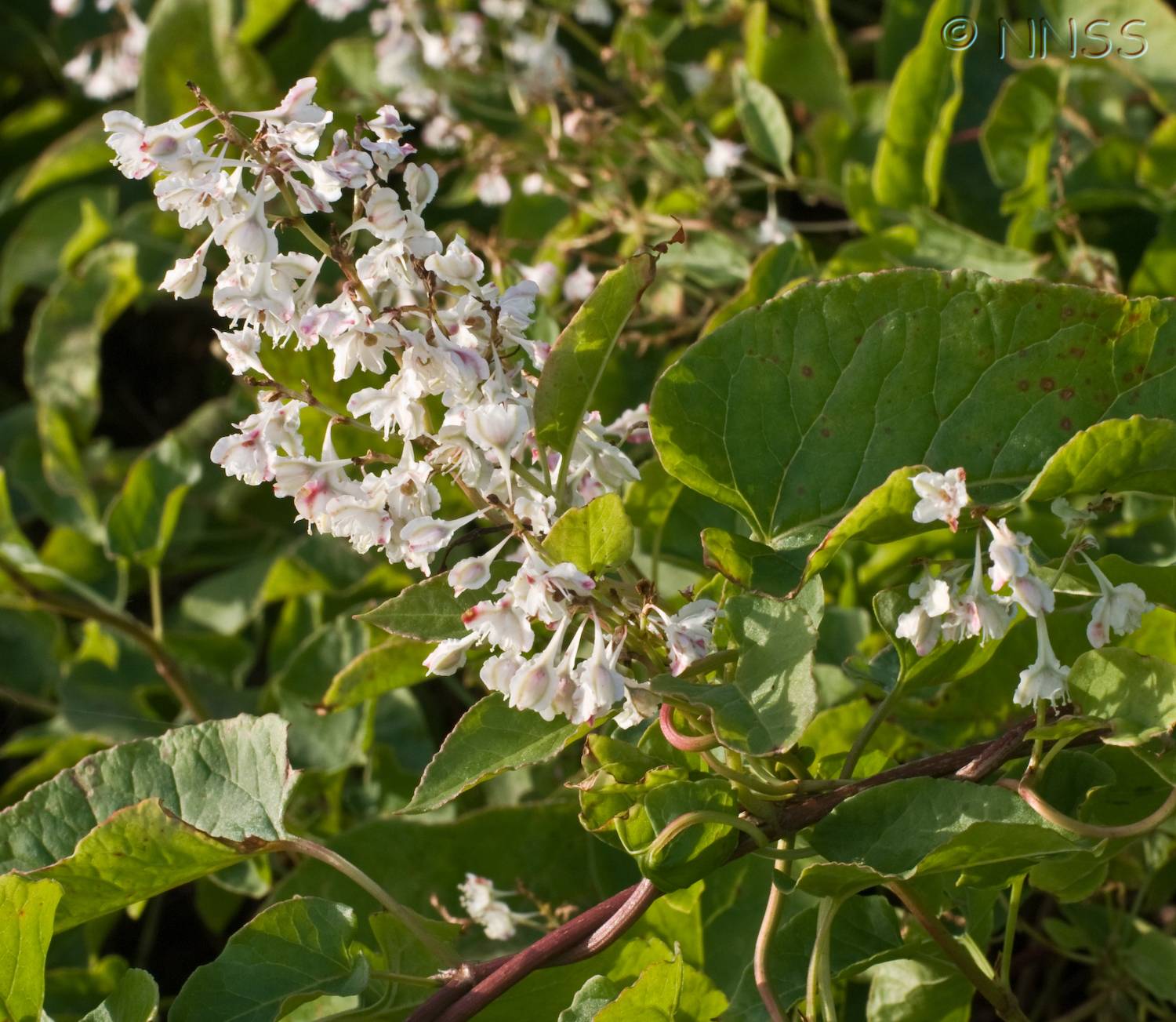
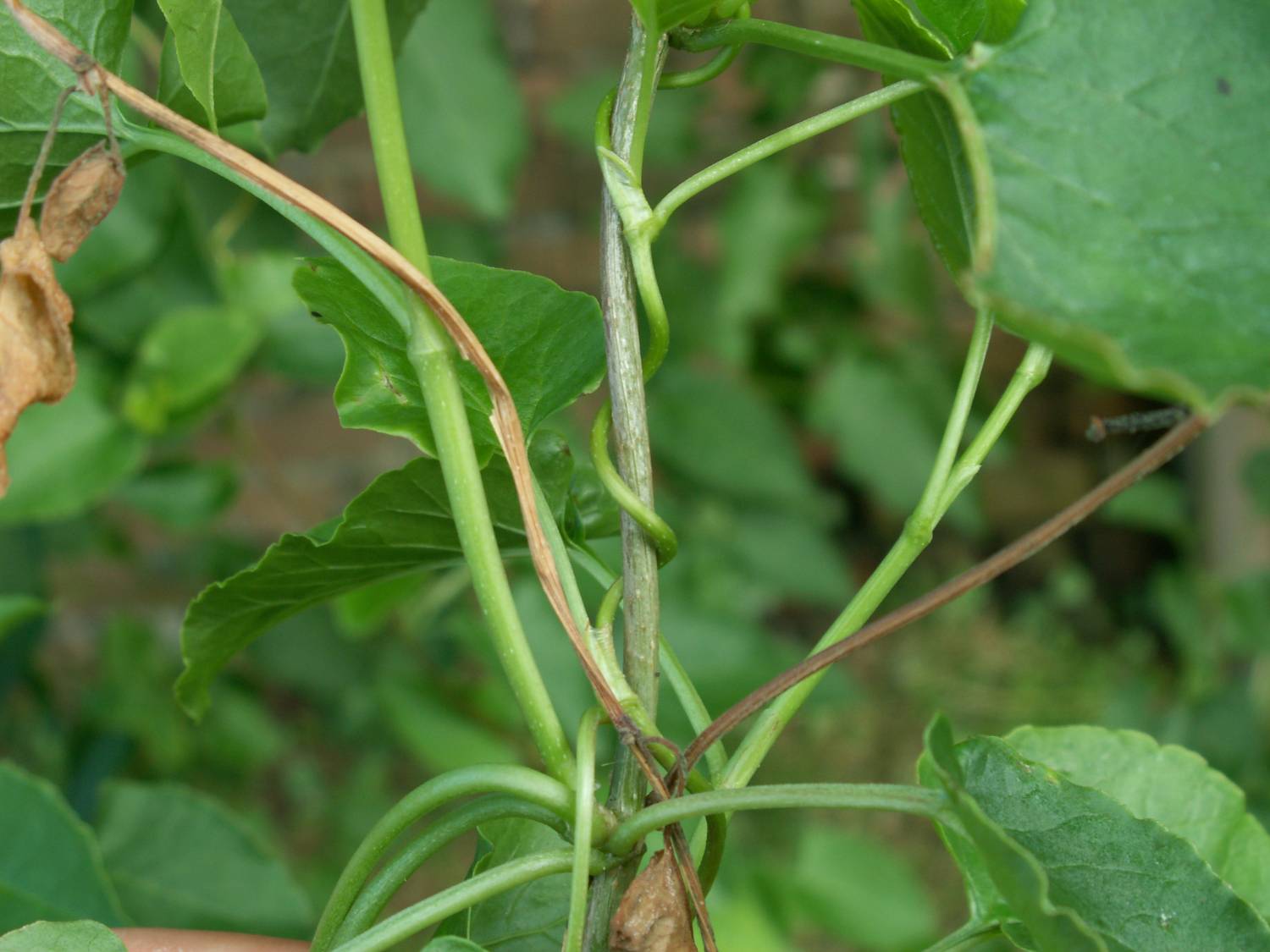
Russian-vine is a perennial deciduous woody climber which grows exceedingly rapidly to 10m or more. Leaves are simple and ovate-oblong. Dense panicles of small greenish-white flowers are borne on shoot tips between May and October. Achenes (seeds) follow soon after and are dark, shiny and about 2mm wide.
Impact summary: Fallopia baldschuanica, Russian Vine
Its rampant growth-form smothers native vegetation, can topple trees and structures in high winds and catalyses neighbourhood disputes.
Habitat summary: Fallopia baldschuanica, Russian Vine
Typically found in disturbed places where it has been discarded, such as road verges, hedgerows, scrubby places and waste ground.
Overview table
| Environment | Terrestrial |
|---|---|
| Species status | Non-Native |
| Native range | Asia-Temperate, Middle Asia |
| Functional type | Land plant |
| Status in England | Non-Native |
| Status in Scotland | Non-Native |
| Status in Wales | Non-Native |
| Location of first record | v.c.17 |
| Date of first record | 1936 |
Origin
It is a native of central parts of Asia.
First Record
It was first recorded from the wild in GB in 1936.
Pathway and Method
Russian-vine was introduced into GB gardens in about 1894. Its toughness and ability to quickly cover large and/or unsightly areas earned it great popularity with gardeners and it is still widely available as a garden climber. It has escaped from gardens typically as a persistent throw-out but also has the capability to produce viable seed.
Species Status
Widespread in lowland parts of the GB but relatively scarce in Wales, Northern England and Scotland and very rare in Ireland. In the New Atlas of the British Isles it is seen to be recorded from 717 10km squares. Less than 10% of these records originated before 1970 and it appears that it is spreading due to increased popularity of instant screening results in gardens. It was recorded in more than 600 additional 10km squares between 1987 and 1999 although this may be as a result of more recorder effort. It is regarded as invasive in parts of Europe (Germany, Spain, Italy and Slovenia) and many states in the USA.
Dispersal Mechanisms
Most commonly, Russian-vine spreads vegetatively when thrown out from gardens. It readily survives uprooting and can spread through stem layering and root fragments. It also produces seed, though seedlings are relatively infrequent.
Reproduction
It produces bisexual flowers between July and October followed by shiny dark achenes.
Known Predators/Herbivores
There are no known natural enemies of Russian-vine in GB.
Resistant Stages
It is a perennial species that drops its leaves in winter. It is tolerant of temperatures as low as -20oC but is sensitive to long periods of frost. Its rhizomes have considerable regeneration potential. Seeds are relatively large but their viability in the seed-bank is not known.
Habitat Occupied in GB
Russian-vine is a lowland invader of disturbed habitats, typically found growing where it has been thrown out on roadsides and rubbish-tips, scrubby places and hedges. It tolerates many different types of soil.
Spreading outwards from the Home Counties and Oxfordshire, it is frequent in southern and eastern England, the Welsh borders and the Midlands. It appears to grow most vigorously on sandy soils.
Environmental Impact
Because this plant climbs so rapidly, it grows over shrubs and trees and rapidly out-competes them for light and space. It can grow up to 10m away from its rootstock. It also hybridises (rarely) with the highly invasive Japanese Knotweed Fallopia japonica to produce another problematic knotweed F. x conollyana.
Health and Social Impact
Russian-vine has been promoted by the horticultural trade as an excellent screening plant and as such it has been widely planted in garden situations. Once established, its rampant growth can get out of control, causing disputes between neighbours. It can also restrict visibility for road users.
Economic Impact
Russian-vine can damage power and telephone lines, trees, shrubs and boundary structures due to its sheer biomass.




Identification
Stace, C.A. (2010) New flora of the British Isles, Third Edition, Cambridge University Press, Cambridge.
Biology, ecology, spread, vectors
Preston, C.D., Pearman, D.A. & Dines, T.D. (2002) New Atlas of the British and Irish Flora, Oxford University Press, Oxford.
Distribution maps from the NBN Gateway: www.searchnbn.net/searchengine/search.jsp?tab=1&pg=1&searchTerm=Fallopia +baldschuanica
Management and impact
GB Non-native Species Secretariat: https://secure.fera.defra.gov.uk/nonnativespecies/home
General
Mini-datasheet compiled by EPPO: www.eppo.org
Spotted this species?
Distribution map
View the Distribution map for Russian Vine, Fallopia baldschuanica from BSBI
ID Sheet
ID Sheet for Russian vine. See a full list of non-native species ID Sheets.
Risk assessment
Risk assessment for Russian vine. See a full list of non-native species Risk assessments.