

Few-flowered Garlic - Allium paradoxum
Expand and collapse the sections below by clicking on the title or + / - icons.
Short description of Allium paradoxum, Few-flowered Garlic
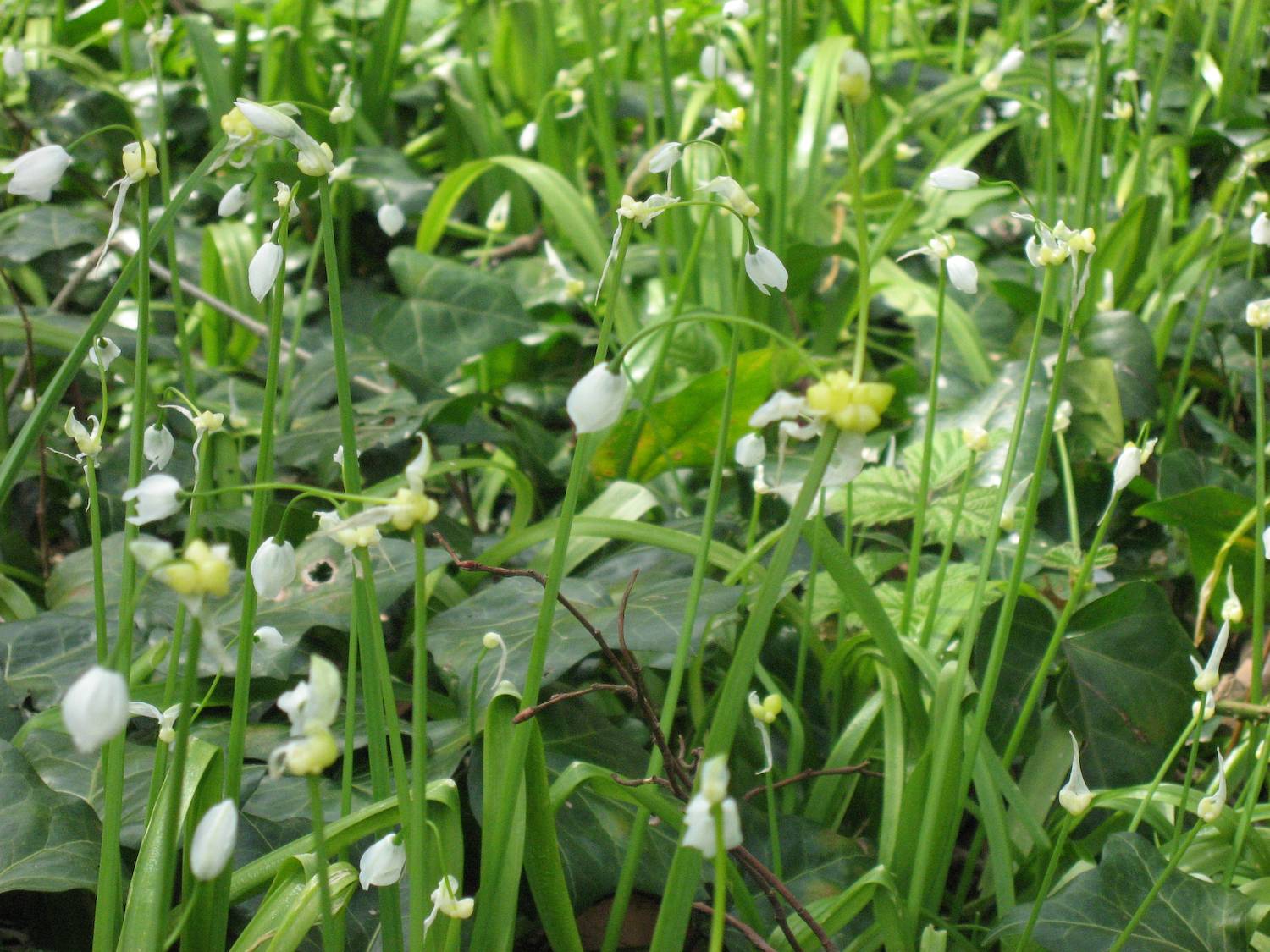
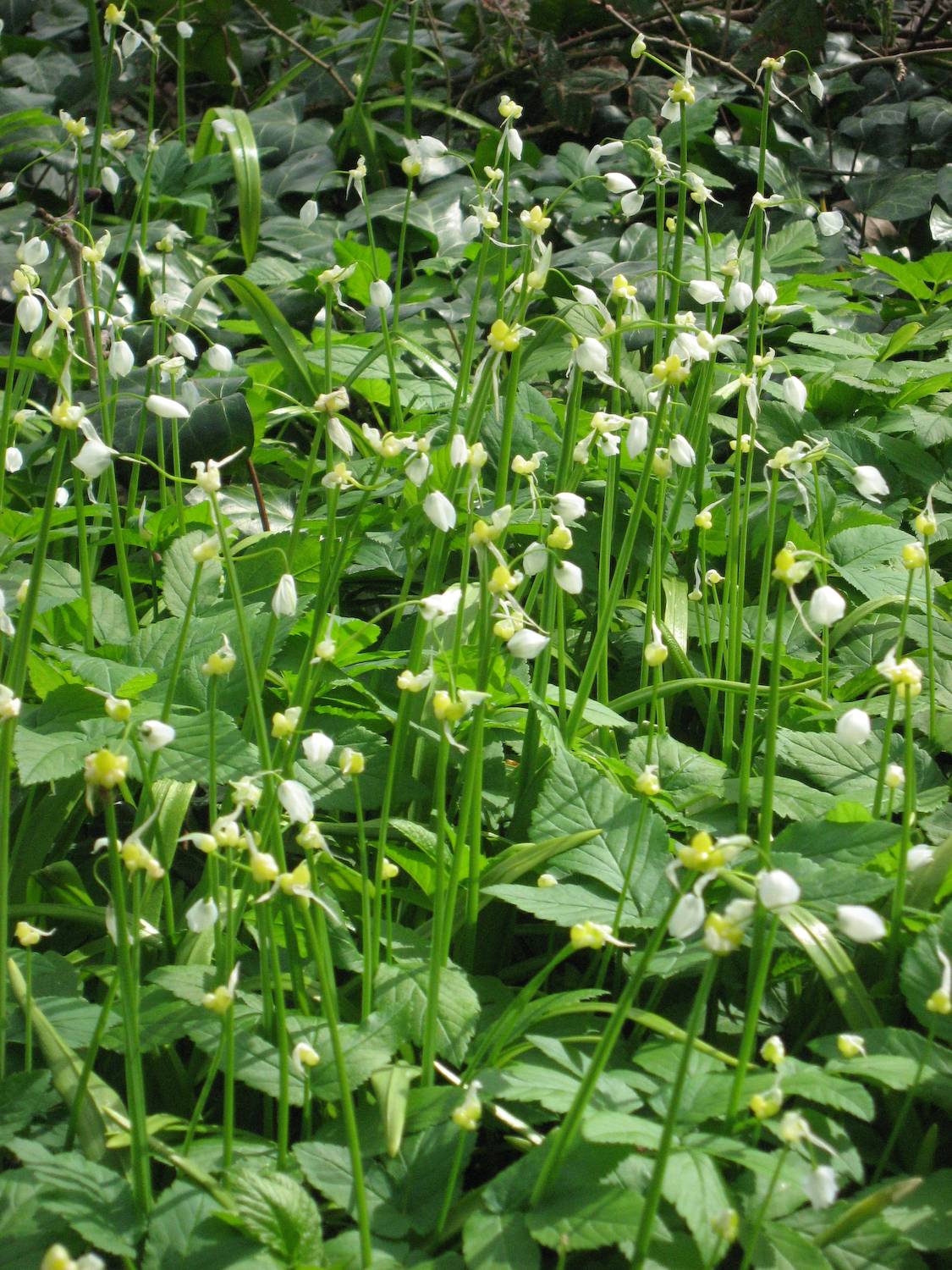
A bulbous, perennial herb with a pungent onion odour. Stems are triangular in cross section. Inflorescences consist of many small yellow bulbils, with or without small white flowers. Flowers occur in April / May.
Impact summary: Allium paradoxum, Few-flowered Garlic
By forming dense carpets of leaves very early in the year it competes directly with native plant species, especially in woods. Species particularly affected include vernal woodland species such as Adoxa moschatellina, Chrysosplenium alternifolium and Primula vulgaris. Grasses and many other hedgerow species are little affected as the Allium paradoxum dies back completely by early June. There is little competition with native riparian species as they almost all shoot later in the season and easily penetrate the Allium paradoxum which is already dying back.
In habitats free of native vernal species Allium paradoxum adds to biodiversity with little adverse impact. Thus it can provide a welcome vernal ground flora in species-poor plantations,
Habitat summary: Allium paradoxum, Few-flowered Garlic
Woodlands, especially in semi-shade and damp soil conditions.
Overview table
| Environment | Terrestrial |
|---|---|
| Species status | Non-Native |
| Native range | Caucasus, Iran |
| Functional type | Land plant |
| Status in England | Non-Native |
| Status in Scotland | Non-Native |
| Status in Wales | Non-Native |
| Location of first record | v.c.83 (Moredon) |
| Date of first record | 1849 |
Origin
Native of the Caucasus and Iran.
First Record
Introduced into cultivation in 1823 and first recorded in the wild in 1849.
Pathway and Method
Introduced into GB as a horticultural plant and spreading due to its ability to produce large quantities of vegetatively produced bulbils that are spread by water along rivers, by vehicle tyres along roads and tracks, by animals and as dumped garden waste. This is as a weed in herbaceous garden material gifted between gardeners.
Species Status
One of the top 100 species that have shown the greatest relative increase between the two atlas recording periods (1930 – 1969 and 1987 -1999). It has naturalised in a number of European countries including Ireland and the Czech Republic. It is, however, considered a protected plant species in Russia.
Dispersal Mechanisms
Seeds are rare and may not be viable. The vegetatively produced bulbils can be spread over greater distances by, for instance, cars along roads, by walkers and fishermen who inadvertedly pick up the bulbils on their boots, while water movement (especially floods) can distribute bulbils easily along the edges of waterways and across the flood plain.
Reproduction
Flowers are insect pollinated. Extensive vegetative reproduction can be achieved via the bulbils that are produced in the inflorescence.
Known Predators/Herbivores
None known.
Resistant Stages
None known.
Habitat Occupied in GB
A species of disturbed habitats, naturalising in woods, grassy places, rough ground and waste places, as well as roadsides and riverbanks.
Locally abundant in southern Scotland and south east England, especially along the River Tweed and its tributaries around Glasgow, Edinburgh and Cambridge. Elsewhere there are scattered populations. It is increasing rapidly throughout its GB range especially in southern Scotland and it is colonising additional areas, such as the River Tyne (Northumberland) and the Lake District. Dumping has now brought it to the coast but it is doubtful whether the bulbils have colonised by sea currents after washing down rivers to the sea.
Environmental Impact
None known.
Health and Social Impact
The leaves and bulbs have culinary and potential medicinal uses. There have been cases of poisoning when large quantities have been eaten. Other mammals can also be affected; dogs seem particularly susceptible. The juice of the plant has been used as a moth repellent.
Economic Impact
None known.

Identification
Clement, E.J., & Foster, M.C. (1994) Alien plants of the British Isles. London: Botanical Society of the British Isles.
Stace, C. (2010). New Flora of the British Isles. 3rd edition. Cambridge
Biology, ecology, spread, vectors
Stace, C. (2010). New Flora of the British Isles. 3rd edition. Cambridge
Management and impact
General
Plants for a Future website
http://www.pfaf.org/user/Plant.aspx?LatinName=Allium+paradoxum
Online Atlas of the British and Irish Flora - online resource available from
http://www.brc.ac.uk/plantatlas/index.php?q=plant/allium-paradoxum
Spotted this species?
Distribution map
View the Distribution map for Few-flowered Garlic, Allium paradoxum from BSBI

Native range map
View an interactive native range map for Few-flowered Garlic, Allium paradoxum
Allium paradoxum is listed under Schedule 9 of the Wildlife and Countryside Act 1981. Read more about Non-native species legislation.